

Scintilla: Redefining Propulsion Economics for Rapid Response
High-performance, cost-efficient bi-propellant propulsion enabling the Optimus Viper Rapid Response Vehicle to deliver unmatched dollar-per-delta-V value.
Overview
Propulsion Built for Scale
Scintilla represents a fundamental rethink of spacecraft propulsion design philosophy, prioritising manufacturability and cost-efficiency without compromising performance. The result is a bi-propellant chemical propulsion system that delivers up to 50N of thrust with exceptional re-ignitability, enabling the complex proximity operations and multi-target servicing missions that define our rapid response capability.
Key Achievements
- > 100 ignition cycles without performance degradation.
- Specific impulse of 270 seconds.
- Thermal stability confirmed throughout long duration burns.
- Scalable design architecture supporting multiple thrust configurations.
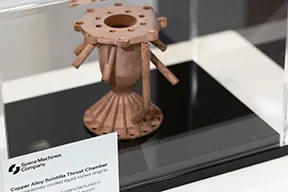
Performance Metrics
| Capability | Specification | Value |
|---|---|---|
| Thrust | 20N - 50N available (300N+ in development) | |
| Specific Impulse (Isp) | 270s (300s in development) | |
| Ignition Cycles | 100+ (higher tolerance available) | |
| Propellant Combination | Bipropellant Chemical (N2O + Ethane) | |
| Cooling Method | Regenerative | |
| Throttle Range | Ground-configurable (multiple thrust settings) | |
| Heritage Status | Flight-ready |
Development Journey
Designed for Manufacturing Reality
Traditional spacecraft propulsion systems are engineered for maximum performance, often requiring exotic materials, complex manufacturing processes, and extensive hand-finishing. These approaches are incompatible with the scale and speed needed for rapid response constellations. Scintilla was conceived differently. From the first design iteration, manufacturability was a primary requirement, not an afterthought.
Leveraging Advanced Manufacturing
We utilised advanced additive manufacturing techniques, specifically laser powder bed fusion, to rapidly iterate through design variations and validate performance across different material compositions. Partnering with CSIRO enabled us to test multiple metal alloy options through precision 3D printing, accelerating our material selection process. This manufacturing approach allowed us to:
- Integrate complex internal cooling channels that would be impossible with traditional manufacturing.
- Reduce part count through consolidated designs.
- Rapidly test design variations and material compositions.
- Establish production processes compatible with high-volume manufacturing.
Testing and Validation
Scintilla has undergone extensive ground testing to validate performance across the full operational envelope. Our dedicated test facility enables rapid iteration and comprehensive characterisation of thrust performance, thermal behaviour, and operational reliability. The system has demonstrated consistent performance across thousands of ignition cycles, proving the durability required for multi-target servicing missions where a single vehicle may execute dozens of orbital manoeuvres.
Technical Design
Green Bi-Propellant Architecture
Scintilla employs a bi-propellant chemical architecture using ethane (C₂H₆) and nitrous oxide (N₂O). This propellant combination offers several operational and safety advantages:
- Readily available and cost-effective.
- Excellent properties as a coolant.
- Safer handling characteristics than hypergolic alternatives.
- Self-pressurising.
- Excellent storage stability.
The "green" designation reflects the significant safety and environmental advantages over traditional hypergolic propellants, which are highly toxic and require extensive safety protocols for ground handling.
Configurable Thrust Output:
While not throttleable during flight, Scintilla supports multiple thrust configuration settings that can be selected during vehicle integration. This flexibility allows mission planners to optimise the propulsion system for specific mission profiles, trading between maximum thrust and propellant efficiency based on operational requirements.
Reignitability for Complex Operations:
The ability to execute numerous ignition cycles without degradation is fundamental to the rapid response mission model. Traditional chemical propulsion systems often face limitations in restart capability, constraining mission designers to simple orbital transfers. Scintilla demonstrated re-ignitability enables:
- Multiple target inspections within a single mission.
- Complex proximity operations requiring frequent thrust adjustments.
- Extended mission durations with numerous orbital manoeuvres.
- Fine control for precision station-keeping.
Test Infrastructure
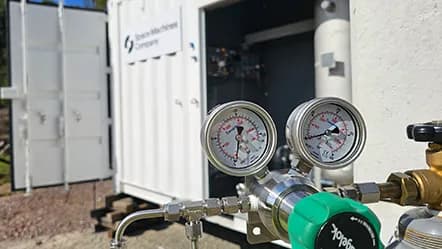
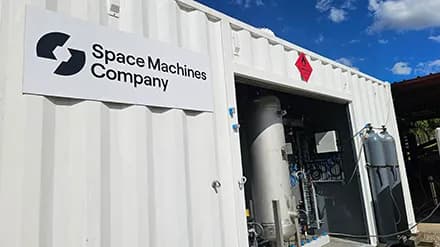
Purpose-Built Test Facility
Developing and validating a new propulsion system requires dedicated test infrastructure. Our test facility enables comprehensive characterisation of Scintilla performance across all operational conditions, from cold start sequences to sustained high-duty-cycle operations.
- 80 bar Working Pressure.
- 1/2 Inch Lines.
- Approx 0-2 kg/s Flow Rates.
- Programable Logic Control.
- Pressure, Temperature, Mass Flow Instrumentation.
Enabling Rapid Response
The Foundation of Optimus Viper
Scintilla is the propulsion heart of the Optimus Viper Rapid Response Vehicle, directly enabling the "roadside assist for space" service model. The system combination of high re-ignitability, compact packaging, and production-ready design makes possible:
- 500 m/s total delta-V — Sufficient for complex multi-target missions across multiple orbital regimes.
- Rapid deployment readiness — Simplified propellant handling enables faster launch integration.
- Cost-effective operations — Manufacturing approach supports the paradigm-shifting low target cost per vehicle.
- Mission flexibility — Multiple ground-configurable thrust settings for diverse operational requirements.
The propulsion system represents less than 1% of total vehicle cost while delivering the critical capability that distinguishes rapid response vehicles from traditional spacecraft.
Production
Scaling for Constellation Deployment
Scintilla manufacturing approach was designed from inception to support SMC goal of producing 30+ Optimus Viper vehicles annually. The additive manufacturing foundation enables:
- Parallel production of multiple units.
- Rapid qualification of design improvements.
- Reduced supply chain complexity.
- Quality consistency across production runs.
Future Standalone Availability:
While Scintilla is currently integrated as part of the complete Optimus Viper system, we recognise the broader market potential for a cost-efficient, high-performance propulsion system designed for manufacturing scale. We are evaluating pathways to offer Scintilla as a standalone propulsion solution for small satellite manufacturers and constellation operators who share our philosophy of prioritising cost-per-capability over feature maximisation. If you are interested in exploring Scintilla for your propulsion requirements, we invite you to register your interest below.